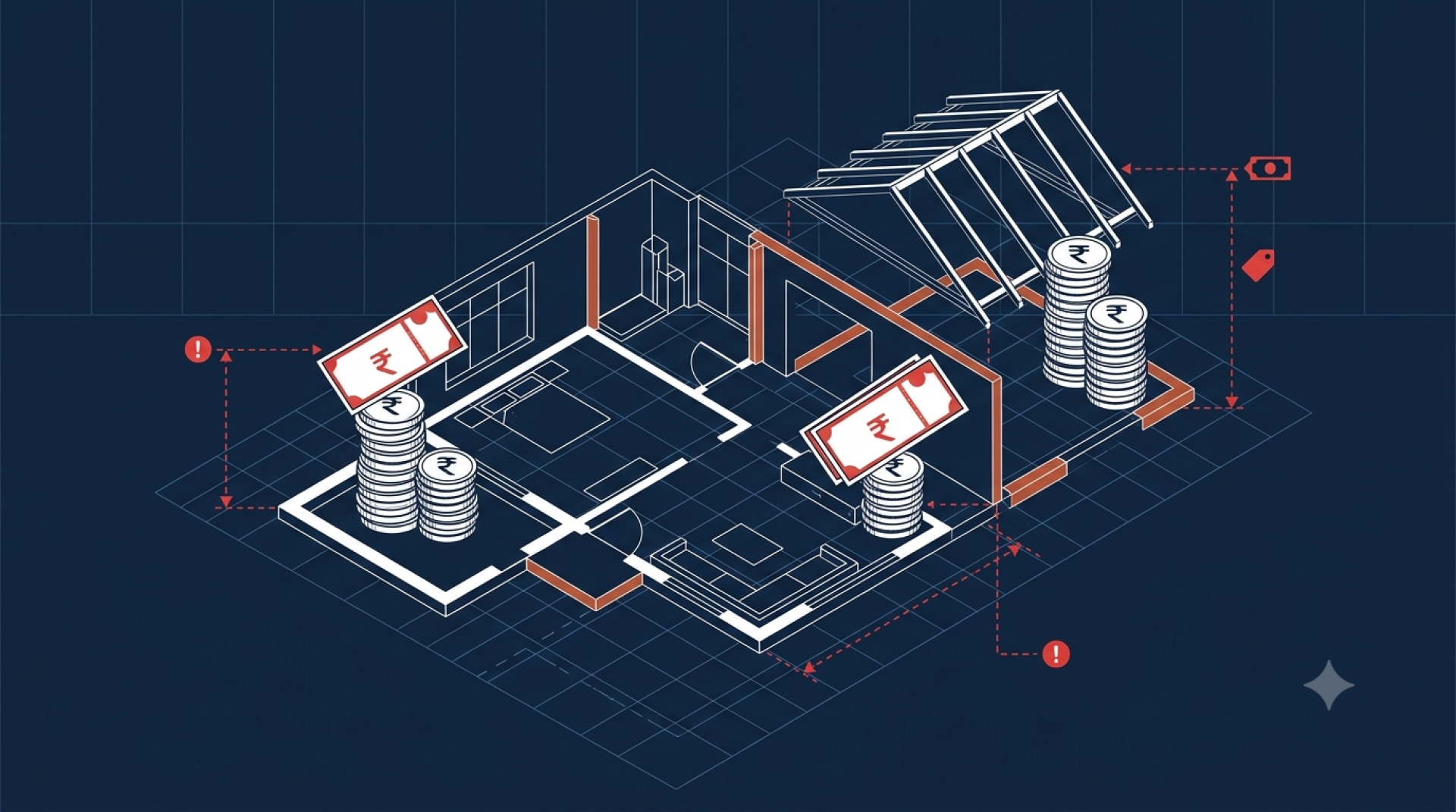
Ask any family who has finished building a house in Nepal one question — "Did it cost what you expected?" — and almost none will say yes. Not because contractors lie, but because a house budget in Nepal is never just dhalan + finishing. It's a long chain of permits, tests, fluctuating material prices, and connection charges that nobody hands you as a single list. This guide puts that list in front of you before you buy the land.
01 Land & Legal Costs Beyond the Purchase Price
The price per aana or ropani quoted by the seller is only the headline number. Before you own a buildable plot, several charges attach themselves to that price.
- Registration (Malpot) fees — typically 4–5% of the government-assessed land value, paid at the land revenue office when transferring the lalpurja.
- Capital gains tax on the seller's side that often gets negotiated into the buyer's price indirectly.
- Surveyor and Kitta plotting charges if the land needs to be subdivided or re-measured.
- Right-of-way (bato) costs — landlocked plots may require you to purchase legal road access separately.
Buyers who budget only the per-aana rate are typically short by this margin before construction even begins.
02 Municipality Permits & the Naksha Pass
Every municipality in Nepal requires an approved building map (naksha pass) before construction starts. This is one of the most underestimated line-items because it involves several sub-fees, not one.
- Map design fee paid to the architect or engineer preparing the drawings.
- Municipality processing fee, which scales with plot size and built-up area.
- Structural drawing approval, mandatory in most municipalities post-earthquake building codes.
- Re-submission costs if the first design is rejected for setback or ratio violations — a very common delay.
Why this catches people off guard
Families often assume the "engineer fee" is a flat, one-time cost. In practice, revisions triggered by municipal feedback can add 15–25% to the original design fee, plus weeks of delay that push labor mobilization costs later too.
03 Soil Testing & Structural Over-Design
Many self-builders skip soil testing to save a small upfront fee — and pay for it many times over in the foundation.
- Soil bearing capacity test — skipped by an estimated majority of small residential builds, despite being the single biggest predictor of foundation cost.
- Extra excavation and pile foundation costs when soil turns out weaker than assumed, common in Terai and reclaimed land plots.
- Retaining wall requirements on sloped Hilly-region plots, rarely priced into the initial quote.
A soil test costing a few thousand rupees can prevent a foundation redesign costing lakhs mid-construction.
04 Rebar, Cement & Material Price Volatility
Contractor quotes are usually locked at a snapshot price. Construction in Nepal frequently runs 8–14 months, and steel and cement prices move independently of your contract.
- Rebar (rod) price swings — steel prices in Nepal have historically moved 15–30% within a single construction cycle due to import duty and global steel price changes.
- Cement price differences between brands and seasonal demand spikes, especially before the dashain-tihar construction rush.
- Transportation surcharges for remote or hill plots where trucks can't access the site directly, requiring manual carrying (bhari) labor.
// A simple way to sanity-check a material budget before locking a contract
const estimateMaterialRisk = (baseQuote, volatilityBuffer = 0.15) => {
  const worstCase = baseQuote * (1 + volatilityBuffer);
  return {
    baseQuote,
    recommendedBuffer: baseQuote * volatilityBuffer,
    planFor: worstCase
  };
};

console.log(estimateMaterialRisk(2500000));
// → Always plan the cash-flow schedule around "planFor", not "baseQuote"
05 Labor Cost Overruns & Contractor Commission
Labor in Nepal is usually quoted per square foot, but the real cost depends heavily on how the work is supervised.
- Skilled mason shortages during peak season push day rates up mid-project.
- Rework costs from poor initial supervision — plastering or tiling redone due to quality issues.
- Contractor commission on materials, an informal markup (often 5–10%) added when the contractor sources materials on your behalf rather than you buying directly.
06 Utility Connections Nobody Quotes Upfront
| Connection | What's Usually Missed |
|---|---|
| Electricity (NEA) | Meter deposit, transformer distance charge, wiring inspection fee |
| Water supply | Boring/tube-well cost if municipal supply is unreliable, plus pump and tank |
| Sewerage/septic | Septic tank construction where municipal sewer lines don't reach |
| Internet/fiber | Underground conduit pre-installation, often skipped and retrofitted later at higher cost |
07 Boundary Walls, Gates & Site Protection
Compound walls are almost never included in a "house construction" quote, yet they're one of the largest add-on costs for corner or roadside plots — both for privacy and to legally mark plot boundaries against future disputes with neighbors.
08 Finishing, Interiors & the "Last 20%" Trap
Structural work (dhalan, brickwork, plastering) is easy to quote. Finishing is where budgets quietly bleed — and it typically represents far more of total cost than buyers expect going in.
- Tiles, sanitary ware, and paint quality tiers vary 3–4x in price for visually similar options.
- Electrical fittings and switchboards priced per point, but upgraded mid-project as preferences change.
- Furniture and modular kitchen — frequently treated as "later," then rushed and overpaid for at move-in time.
- Curing and monsoon delays that stretch the finishing phase and add site security/watchman costs.
09 The Contingency Buffer Almost Nobody Budgets
Across almost every category above, the pattern repeats: fixed-looking quotes meeting variable real-world conditions. The single most effective planning tool isn't a lower price — it's a deliberate contingency line.
Treat it as a locked reserve, not "extra" money — most self-builders in Nepal end up needing all of it.
Conclusion: Budget the House, Not Just the Building
Building a house in Nepal is rarely derailed by one big mistake — it's the accumulation of small, unquoted line-items: a permit resubmission here, a rebar price jump there, a septic tank nobody priced in. None of these are hidden because someone withheld information from you; they're hidden because most budgets are built around the visible structure, not the full lifecycle of a build.
The fix is simple to state and disciplined to follow: get a soil test before you finalize a foundation design, get your naksha approved before you fix a material budget, and set aside a real contingency fund before your first dhalan. Buyers who plan this way rarely get surprised — they get informed early, and that's the actual difference between a stressful build and a smooth one.